Sunday, 21 December 2014

A potential solution

As mentioned in an earlier blog post clearing areas of forest for cattle ranching is one of the major land use changes that has been occurring in certain rainforests and also significantly contributes to global carbon emissions. One estimate has claimed that cattle ranching is responsible for 3.4% of all global carbon emissions (WWF, 2007) and accounts for 80% of deforestation in Amazon rainforest countries.

Potential solutions to this problem seem fairly radical but some have argued that they are necessary to save the rainforest and reduce carbon emissions. Nepstad et al (2008) argue that Brazil, as the main perpetrator need to do two things. First, to agree to reduce it's rate of deforestation and set a target. The second would be for the global marketplace to effectively exclude Amazonian cattle and soy from the supply chains (those being the main causes of deforestation). I'm not sure how likely this would be to occur, as one not being well informed on the in's and out's of McDonalds' supply chain and any potential link with Amazonian beef. This would undoubtedly create a reduction in income among the countries concerned. Nepstad et al offer the solution of the deficit being made up by REDD (hence why I posted a link to a video in my last blog) or by payments for a tropical forest carbon credits scheme under a U.S. cap and trade scheme.

With the deficit being estimated at between $7 and $18 billion and that only in Brazil's budget mind, I find it fairly difficult to believe that this would ever be carried out. But perhaps that's just the natural sceptic within me. However, that doesn't stop me thinking that if we all cut down on the McDonalds and steak we might be able to alleviate the problem.
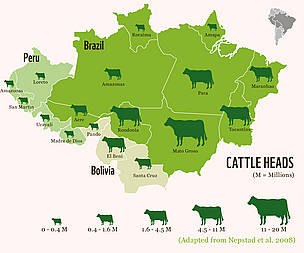
The location of problem cows in the Amazon
That's all for now.

Tuesday, 16 December 2014

A short video on REDD+

I found this video while looking for material. I think it gives a fairly good summary of what REDD+ is, how important it could be and how it could work.

One of it's major points is challenging the discourse behind the value of the rainforest from only being valuable when it's chopped down to one where it is more valuable left standing.

Take a look if you are intrigued. I won't give too much more away.


That's all for now.


Tuesday, 9 December 2014

The rainforest is quite useful you know - Part 2

We've already established that the rainforest can be used to develop medicine. But how else might it be useful?

As a carbon sink. As plant species require carbon dioxide to survive it means that large areas of forest are able to take in large amounts of carbon dioxide from the atmosphere. Going on the consensus that we live in a world with increasing levels of carbon dioxide, which has been said to contribute towards an increase in global temperature levels (IPCC, 2013), large areas of plant life can only be seen as beneficial towards global carbon dioxide levels.

Not a carbon sink

However, there is a danger fast approaching. The rainforests, in particular the Amazon, are approaching a tipping point. This has been seen to be the point at which the rainforest begins to emit carbon rather than take it in from the atmosphere. This is due to deforestation and more recently, drought. Lewis et al (2011) study the effects the droughts of 2005 and 2010 had on the carbon sink effect of the Amazon rainforest (carbon sinks in this case are also known as bio-sequestration). The study mentioned that these two years of drought both contributed carbon dioxide to the atmosphere in terms of 2.2 billion metric tons in 2010 and 1.6 billion metric tons in 2005. When the Amazon was only contributing 0.4 billion metric tons each year as a carbon sink on average these figures stand out fairly substantially. This was particularly alarming as both drought events were supposed to be one in one hundred year events but happened twice within the space of six years. A sign for the future perhaps? With drought conditions becoming more regular in our rainforests, the days of a carbon sink may be coming to an end.

That's all for now.

Wednesday, 3 December 2014

Don't let it burn too much

Fires are dangerous. Fact. But are they a bad thing for the biodiversity of the rainforest?

Hmmm, the answer to this may not be as obvious as it seems. Undoubtedly, if there is a fire in a rainforest there will be a loss of habitat for some species and the destruction of others. This can be seen in many studies (Kinniard & O'Brian, 1998) (Nykvist, 1996). However, some studies have shown that a rainforest can survive in an environment where fire is common and possibly even thrive with the constant re-sprouting (Metcalfe, 2011).

Metcalfe mentions that although many South-East Asian and South American rainforests are damaged heavily by fire those located in Australia have developed some kind of resistance to its destructive power. The wood still burns of course, but 91% of the species, for which there is data, "survive by re-sprouting, root-suckering or coppicing". It is suggested that this may be that due to the fact that smaller fires are a lot more common in Australia and any species which were not either resistant or had coping mechanisms have gone extinct. He does however, highlight that this is a fairly regional example and that there is not much existing data.

Nevertheless, another recent study has shown that fire may become even more dangerous to the rainforest. A joint US-Brazil project by the Woods Hole Research Center highlighted the dangers that as areas of rainforest become drier with the effects of anthropogenic climate change and deforestation an environment is created where fires spread more easily. The study took three plots of rainforest and exposed two out of the three to fires annually or every two to three years. They then left the third plot untouched. In years of drought the fires burned more intensely whereas in years without drought the fires were almost unnoticed (WHRC, 2014).

Left - A aerial view of the 3 experimental fire subplots being used by Center scientists. Right - A field researcher lighting part of the 2009 experimental burn.
Image take from WHRC,(2014)

If this is the case, with reports that El NiƱo is becoming more frequent (Federov & Philander, 2000) thus leading to more frequent droughts, fires could become a huge problem for many areas of rainforest.

That's all for now.