Sunday, 21 December 2014

A potential solution

As mentioned in an earlier blog post clearing areas of forest for cattle ranching is one of the major land use changes that has been occurring in certain rainforests and also significantly contributes to global carbon emissions. One estimate has claimed that cattle ranching is responsible for 3.4% of all global carbon emissions (WWF, 2007) and accounts for 80% of deforestation in Amazon rainforest countries.

Potential solutions to this problem seem fairly radical but some have argued that they are necessary to save the rainforest and reduce carbon emissions. Nepstad et al (2008) argue that Brazil, as the main perpetrator need to do two things. First, to agree to reduce it's rate of deforestation and set a target. The second would be for the global marketplace to effectively exclude Amazonian cattle and soy from the supply chains (those being the main causes of deforestation). I'm not sure how likely this would be to occur, as one not being well informed on the in's and out's of McDonalds' supply chain and any potential link with Amazonian beef. This would undoubtedly create a reduction in income among the countries concerned. Nepstad et al offer the solution of the deficit being made up by REDD (hence why I posted a link to a video in my last blog) or by payments for a tropical forest carbon credits scheme under a U.S. cap and trade scheme.

With the deficit being estimated at between $7 and $18 billion and that only in Brazil's budget mind, I find it fairly difficult to believe that this would ever be carried out. But perhaps that's just the natural sceptic within me. However, that doesn't stop me thinking that if we all cut down on the McDonalds and steak we might be able to alleviate the problem.
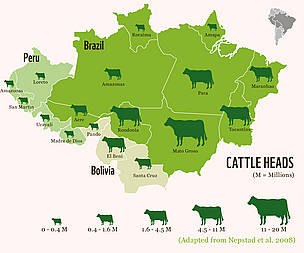
The location of problem cows in the Amazon
That's all for now.

Tuesday, 16 December 2014

A short video on REDD+

I found this video while looking for material. I think it gives a fairly good summary of what REDD+ is, how important it could be and how it could work.

One of it's major points is challenging the discourse behind the value of the rainforest from only being valuable when it's chopped down to one where it is more valuable left standing.

Take a look if you are intrigued. I won't give too much more away.


That's all for now.


Tuesday, 9 December 2014

The rainforest is quite useful you know - Part 2

We've already established that the rainforest can be used to develop medicine. But how else might it be useful?

As a carbon sink. As plant species require carbon dioxide to survive it means that large areas of forest are able to take in large amounts of carbon dioxide from the atmosphere. Going on the consensus that we live in a world with increasing levels of carbon dioxide, which has been said to contribute towards an increase in global temperature levels (IPCC, 2013), large areas of plant life can only be seen as beneficial towards global carbon dioxide levels.

Not a carbon sink

However, there is a danger fast approaching. The rainforests, in particular the Amazon, are approaching a tipping point. This has been seen to be the point at which the rainforest begins to emit carbon rather than take it in from the atmosphere. This is due to deforestation and more recently, drought. Lewis et al (2011) study the effects the droughts of 2005 and 2010 had on the carbon sink effect of the Amazon rainforest (carbon sinks in this case are also known as bio-sequestration). The study mentioned that these two years of drought both contributed carbon dioxide to the atmosphere in terms of 2.2 billion metric tons in 2010 and 1.6 billion metric tons in 2005. When the Amazon was only contributing 0.4 billion metric tons each year as a carbon sink on average these figures stand out fairly substantially. This was particularly alarming as both drought events were supposed to be one in one hundred year events but happened twice within the space of six years. A sign for the future perhaps? With drought conditions becoming more regular in our rainforests, the days of a carbon sink may be coming to an end.

That's all for now.

Wednesday, 3 December 2014

Don't let it burn too much

Fires are dangerous. Fact. But are they a bad thing for the biodiversity of the rainforest?

Hmmm, the answer to this may not be as obvious as it seems. Undoubtedly, if there is a fire in a rainforest there will be a loss of habitat for some species and the destruction of others. This can be seen in many studies (Kinniard & O'Brian, 1998) (Nykvist, 1996). However, some studies have shown that a rainforest can survive in an environment where fire is common and possibly even thrive with the constant re-sprouting (Metcalfe, 2011).

Metcalfe mentions that although many South-East Asian and South American rainforests are damaged heavily by fire those located in Australia have developed some kind of resistance to its destructive power. The wood still burns of course, but 91% of the species, for which there is data, "survive by re-sprouting, root-suckering or coppicing". It is suggested that this may be that due to the fact that smaller fires are a lot more common in Australia and any species which were not either resistant or had coping mechanisms have gone extinct. He does however, highlight that this is a fairly regional example and that there is not much existing data.

Nevertheless, another recent study has shown that fire may become even more dangerous to the rainforest. A joint US-Brazil project by the Woods Hole Research Center highlighted the dangers that as areas of rainforest become drier with the effects of anthropogenic climate change and deforestation an environment is created where fires spread more easily. The study took three plots of rainforest and exposed two out of the three to fires annually or every two to three years. They then left the third plot untouched. In years of drought the fires burned more intensely whereas in years without drought the fires were almost unnoticed (WHRC, 2014).

Left - A aerial view of the 3 experimental fire subplots being used by Center scientists. Right - A field researcher lighting part of the 2009 experimental burn.
Image take from WHRC,(2014)

If this is the case, with reports that El Niño is becoming more frequent (Federov & Philander, 2000) thus leading to more frequent droughts, fires could become a huge problem for many areas of rainforest.

That's all for now.

Thursday, 27 November 2014

The rainforest is quite useful you know - Part 1

Why bother with the rainforest? I hear you ask. What could we possibly use it for?

Medicine. Much of the medicine used today (even in modern medicine, yes) comes from plants found in rainforests. Estimates seem to range from 25% to 40%. Additionally, we haven't even tested all the plant species in the rainforest for it's potential medicinal use. Tyler (2001) suggests that only about 5% of all plants have been tested opening up huge avenues of potential for new medicines to be developed from rainforest flora. For those of you interested in placing monetary values on resources, the rainforest is estimated to have a value of $167 billion in terms of the value to society that can be gained from medicines developed from rainforest plants.

Tyler's study goes on to have a more negative viewpoint with an almost despairing conclusion mentioning that he doesn't believe that the rainforest can be maintained in its current state and we may have to act quickly to get the most out of it in terms of benefits to the health of a global society. On the other hand, he does tell it to enjoy it as it lasts at least!


Were some of these developed from plants in your local rainforest?
It is probably worth adding that we must take caution when trying to discover a new medicine that may derive from a rainforest plant. A significant proportion of modern medicine which came from rainforest plants were discovered because of local people who already used the plant for medicinal purposes. The potential of the rainforest to provide new medicine must therefore be taken with a pinch of salt as we may have already discovered a large proportion of potential medicine due to the local people but also the amount of plants that we have not studied is so vast, it may be hard to even find a starting point (Voeks, 2004).


For some more information on some specific medicines which came from the rainforest check out this link.

That's all for now.

Wednesday, 19 November 2014

Land use change. The enemy identified?

The Millenium Ecosystem Assessment in 2005 identified land use changes as one of the most important direct drivers of biodiversity loss.

Red is always bad you know...

This diagram shows how much of an impact each driver has in each forest biome. Darker colours indicate how much of an impact each driver has had on biodiversity over the last century and the direction of the arrows indicate how rapid the increase (or decrease if the arrow is downwards) has been. The box we are most interested in is the habitat change in tropical forests. This usually consists of land use change, for example, chopping down forests to make way for cattle ranching (beef burgers have got to come from somewhere right?). The dark red box with an arrow pointing straight up means that it's had a very high impact on biodiversity and it has occurred rapidly.

So what are some of the major land use changes that have occurred in the rainforest?


The majority of the land use changes are moving from areas of forest to areas which are used for farmland (both pasture and arable land) although there are some situations where forestry has made way for urban settlements. One particularly striking statistic from the Amazon is brought up by Laurance (1998) in that deforestation rates were over two million hectares a year in the mid 1990s. These were largely being used for cattle ranching and industrial soybean farms. Laurance goes further on to mention that the areas being deforested are not centralised around one region but have been migrating as sorts. This then means that forests could become more fragmented leading to a forest that could more easily be devastated by fire or climatic variations. One example of this occurring happened during the El Niño drought of 1997-1998 where fires spread through 3.4 million hectares of land in Northern Amazonia.
Brazil's cattle ranching industry is the biggest in the world producing over $5 billion a year

But is it right for us to tell people what to do with their land?

You may be happy to hear that partly due to international pressures the amount of rainforest that is protected from logging is increasing. An example can be found here. However, a thought has struck into my head. Is it right for us, and by us I mean an international community in general, to tell countries that have rainforest in their political boundaries, what to do with their land? During our industrial revolution in Britain did anyone tell us what to do with our resources or land? Didn't think so...Is it therefore right for us to put huge pressure on these countries with rainforest to manage it the way we want them to manage it rather than help their economic development? Just a thought...before I open a can of worms on myself.

That's all for now.

Wednesday, 12 November 2014

Environment versus biodiversity. Who will win?

There are many different factors which impact on the biodiversity within rainforests. The one we are going to be focusing on in this blog post is the climate.

A recent study by Nehren et al (2013) discusses the impact of natural climate change on an area of rainforest in South East Brazil in the late Holocene (the most recent geological epoch which began approximately 11500 years ago at the end of the last ice age). Their studies concluded that natural climate change can have a huge impact on the vegetation cover and composition of rainforests. The rainforest in SE Brazil expanded under warm and humid conditions in the late Holocene. This expansion in turn affected the local environmental conditions and could have also had an impact on a global climate system. Locally, soil development, weathering intensity and geomorphic processes where enhanced. More globally speaking, an expansion of the rainforest would lead to a larger area of land acting as a carbon sink reducing the impacts of rising carbon dioxide levels (more on this in a future blog post).

So why is the climate so important for rainforests? Well, the extreme amount of rainfall (>1500mm/year), the lack of seasonal variation (due to the proximity to the equator) and the high temperatures all contribute to an environment which encourages high rates of growth. We all know that plants need sunlight, water and nutrients to grow and the rainforest provides all of these (Gaughan, 1998).

But what dangers might the rainforest face relating to its biodiversity and climate? We can safely say that it is not just one climatic factor that is responsible for the diversity seen in the rainforest but say that one of these climatic factors were to change rapidly. Let's say, an increase in temperature, this would force an organism, which remember, is specifically adapted to thrive in its current environment, away from the equator in order to stay within its optimum temperature range. As this species moves away from the equator (if it can, plants don't have legs), it will experience a greater variation in temperature range which it would then need to adapt to. Essentially in order to survive this species would need to win the race of adaptation versus environmental change. If we have more losers in the race to beat the environment, certainly biodiversity will be an overall loser.

I'll leave you with something some of you might be wondering. Why does it rain so much in a rainforest? The link to some great basic information can be found here.

That's all for now.

Tuesday, 4 November 2014

Welcome

As this is my first post I will outline the focus of my blog and the main topic areas which I will discuss and also why I believe it demands such discussion.


The rainforest is an area of the world which has seen a lot of landscape change over the past century with man's desire for resources hitting new highs year on year. The demand for some of the resources that the rainforest provides, such as wood and cattle ranching, could be seen to be hitting unsustainable levels and the vast areas of rainforest that appear to be disappearing is approaching worrying levels.

This blog aims to evaluate whether or not we are running out of rainforest too quickly and if it is too late for us to be able to keep the rainforest in a stable state or if it will simply disappear. This blog will also look at the different land use changes that are occurring, the history of the rainforest itself and possible methods for saving the rainforest for future generations.

So what is a rainforest? According to the Collins Online Dictionary it's a dense forest found in tropical areas of heavy rainfall. Trees are broad-leaved and evergreen and the vegetation tends to grow in three layers (undergrowth, intermediate trees and shrubs, and very tall trees, which form a canopy).Below is a map displaying the current worldwide distribution of rainforests.

Rainforests cover 6% of the world's land surface but they account for over half of the planet's biodiversity. For this reason they can be seen to have huge value, whether that be intangible value or an estimated monetary value and some would therefore argue that they need protecting. The rainforests of the world can be seen to have value not just through their biodiversity but also through their wider impact on the climate, the various possible resources we can find in the rainforest and its importance in medicine (Taylor, 2004). These topics will be discussed further in future blog posts.

On a personal note, I believe that discussion about the rainforest's biodiversity and our use of it's land is demanded because, as Gibson et al (2011) discusses, our land use changes threaten the biodiversity of the rainforest and there is no substitute in terms of biodiversity for original, primary, undisturbed rainforest (no matter how far recovery attempts go). If the rainforests truly contain over half of all our planets species, surely their endangerment is something worth discussing?

That's all for now.